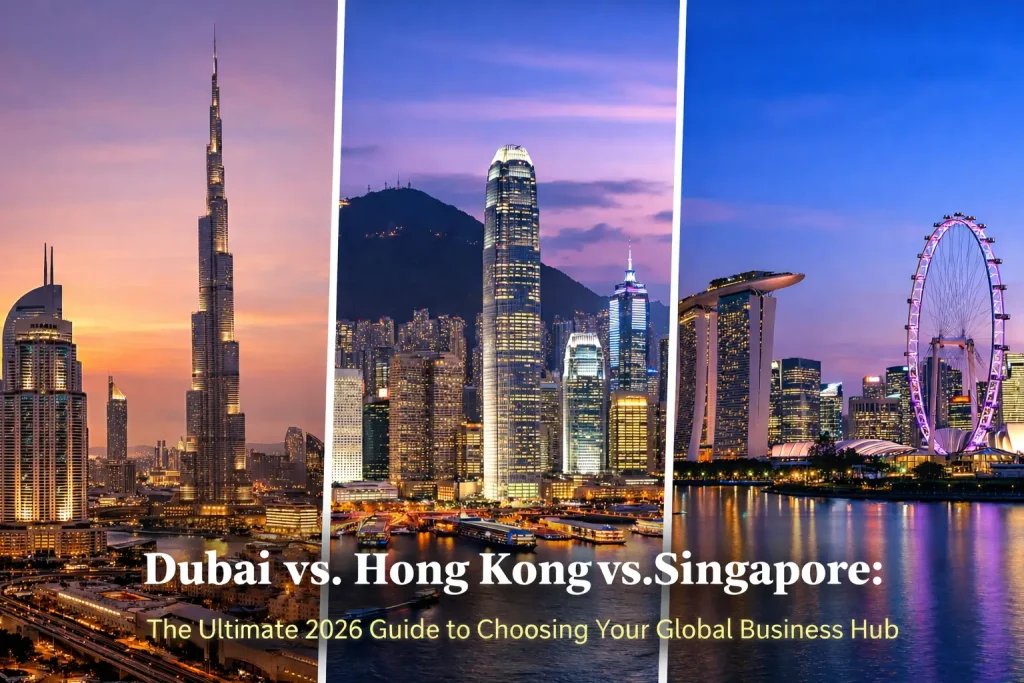
Dubai vs. Hong Kong vs. Singapore: The Ultimate 2026 Guide to Choosing Your Global Business Hub
In today’s fast-changing global economy, selecting the right country to register your business can significantly impact growth, profitability, and long-term sustainability. With international expansion opportunities increasing, entrepreneurs, founders, and business leaders are evaluating Dubai, Singapore, and Hong Kong as potential global hubs.
Each country offers unique advantages, from tax efficiency and ease of company registration to strategic market access and industry-specific incentives. Making the correct choice requires understanding regulatory frameworks, costs, and growth potential.
This guide will help you compare Dubai, Singapore, and Hong Kong in 2026, highlighting critical factors to evaluate before registering your company abroad. By the end, you’ll have actionable insights to inform your global business strategy.

The Ultimate Dubai Business Setup Guide for 2026!
- Introduction: How to Choose the Best Country for Company Registration in 2026
- What Are the Most Important Factors to Evaluate Before Registering a Company Abroad?
- Company Registration Overview: Dubai vs Singapore vs Hong Kong
- Side-by-Side Comparison: Costs, Taxes, and Benefits in Dubai, Singapore & Hong Kong
- Conclusion
- Frequently Asked Questions
What Are the Most Important Factors to Evaluate Before Registering a Company Abroad?
Before choosing a business hub, entrepreneurs should analyse several key factors. Here are the most essential factors:
1. Ease of Company Registration
The time, complexity, and legal requirements of registering a company differ across regions. Key considerations include:
- Process Duration: How many days does it take to incorporate a company
- Documentation: Required documents like passports, proof of address, and business plans.
- Ownership Rules: Are foreign investors allowed full ownership, or do local partners need to be involved?
- Digital Access: Can incorporation be completed online, or is it bureaucratically heavy?
A hub that enables a fast, streamlined registration process saves time and accelerates your market entry.
2. Taxation and Financial Incentives
Taxes are a critical factor in deciding on a global business hub. Entrepreneurs should analyse:
- Corporate Taxes: Compare statutory corporate tax rates, exemptions, and thresholds.
- Personal Income Taxes: Relevant if business owners plan to draw salaries or dividends.
- Free Zones or Tax Holidays: Many jurisdictions offer special zones with zero corporate tax for specific industries.
- Government Grants and Incentives: Some countries support startups with innovation grants, subsidies, or R&D incentives.
Example: Low or zero corporate taxes can significantly increase cash flow for reinvestment, which is crucial for early-stage businesses.
3. Market Access and Strategic Location
The location of a business hub directly impacts your ability to reach key markets efficiently. Entrepreneurs should consider:
- Regional Reach: How close is the hub to your target customers, suppliers, or partners? For example, hubs in the Asia-Pacific region can provide quick access to fast-growing markets such as China, India, and ASEAN countries.
- Trade Agreements: Countries with free trade agreements or preferential trade arrangements reduce tariffs, simplify exports, and enhance competitiveness.
- Logistics and Connectivity: Reliable ports, airports, highways, and digital infrastructure ensure smooth operations for both product-based and service-based businesses.
4. Operational Costs
Operating a business abroad involves multiple expenses. Understanding these costs upfront can prevent unexpected financial strain:
- Office Space and Facilities: Rental rates vary widely between regions and city centres versus free zones or suburban areas. Some hubs offer co-working spaces or flexible office solutions to reduce initial costs.
- Employee Salaries and Benefits: Labour costs differ depending on local talent availability and skill levels. Highly skilled professionals may come at a premium, but can accelerate your business operations.
- Legal, Accounting, and Compliance Fees: Ongoing compliance, audits, and reporting can add up. Some jurisdictions have simplified processes that reduce the need for extensive legal support.
- Licensing and Permits: Industry-specific permits may be mandatory, especially in finance, healthcare, or logistics.
5. Regulatory Environment
A stable and transparent regulatory framework is essential for long-term success. Key factors to evaluate include:
- Investor Protections: Look for laws that safeguard foreign investment and provide dispute resolution mechanisms.
- Intellectual Property Rights: Robust IP laws protect your technology, products, and brand from infringement.
- Profit Repatriation: Some countries restrict the transfer of profits abroad. Choose jurisdictions that allow easy repatriation of dividends and earnings.
- Government Efficiency: Streamlined approvals, digital filings, and clear legal frameworks reduce delays and minimise bureaucratic hurdles.
6. Industry Opportunities
The local ecosystem can determine your business’s success. Entrepreneurs should assess:
- Industry Clusters: Countries with established sectors (e.g., tech in Singapore, finance in Hong Kong, trade in Dubai) offer better infrastructure, partnerships, and market opportunities.
- Skilled Workforce: Availability of professionals in your industry ensures smooth operations and helps maintain a competitive advantage.
- Professional Networks: Access to incubators, accelerators, and business associations can accelerate growth and innovation.
Company Registration Overview: Dubai vs Singapore vs Hong Kong
Once entrepreneurs understand the key factors for evaluating global hubs, the next step is to see how these factors play out in practice. Dubai, Singapore, and Hong Kong are three of the most popular destinations for international business registration in 2026.
Dubai Company Incorporation
Dubai has positioned itself as one of the most attractive global business hubs, offering entrepreneurs a combination of tax efficiency, modern infrastructure, and strategic access to regional and international markets. Companies in Dubai can be established as free zone entities, mainland LLCs, or offshore companies, depending on their operational goals and target markets.
Free Zone Companies:
- Allow 100% foreign ownership.
- Operate in a tax-free environment.
- Benefit from simplified visa and licensing processes.
Mainland Companies:
- Provide access to the broader UAE market.
- Usually requires a local sponsor or partner, which may influence ownership and decision-making authority.
Dubai’s strategic location provides access to markets across the Middle East, Africa, and Europe, benefiting sectors such as trade, logistics, finance, and energy.
Singapore Company Incorporation
Singapore is recognised as one of the easiest and most efficient countries for company registration, offering entrepreneurs a combination of regulatory clarity, tax incentives, and strategic access to Asia-Pacific markets.
Companies in Singapore can be established as private limited companies, sole proprietorships, or branch offices, depending on the business structure and long-term goals.
Private Limited Companies:
- Allow 100% foreign ownership.
- Provide limited liability protection for shareholders.
- Benefit from digital-first registration and streamlined compliance processes.
Sole Proprietorships and Branch Offices:
- Easier and quicker to set up for small businesses or foreign entities.
- May have personal liability for owners in the case of sole proprietorships.
- Provide direct access to the Singapore market and opportunities to expand regionally.
Singapore’s extensive network of free trade agreements makes it an ideal hub for technology, fintech, biotech, and service-based companies.
Hong Kong Company Incorporation
Hong Kong is a leading financial and commercial hub in Asia, offering entrepreneurs a simple regulatory framework, competitive taxation, and direct access to Mainland China and Asia-Pacific markets.
Companies can be incorporated as private limited companies, sole proprietorships, or branch offices, depending on the ownership structure and business goals.
Private Limited Companies:
- Allow 100% foreign ownership, giving complete control to investors.
- Provide limited liability protection to shareholders.
- Features fast incorporation and straightforward compliance procedures.
Sole Proprietorships and Branch Offices:
- Offer quick setup options for small businesses or foreign entities.
- Sole proprietorships carry personal liability, while branch offices allow companies to operate locally without forming a separate entity.
- Enable businesses to access Hong Kong’s domestic market and use the city as a platform to enter Mainland China.
Side-by-Side Comparison: Costs, Taxes, and Benefits in Dubai, Singapore & Hong Kong
| Factors | Dubai | Singapore | Hong Kong |
|---|---|---|---|
| Corporate Tax | 0% (Free Zone), 9% (Mainland) | 17% (startups get exemptions) | 16.5% (local), 0% (offshore) |
| Personal Tax | 0% | 0–22% | 2–17% |
| Ownership | Free Zone: 100% | 100% | 100% |
| Setup Time | 5–15 days | 1–3 days | 1–5 days |
| Minimum Capital | AED 50,000+ | SGD 1 | HKD 1 |
| Operational Cost | Low | Medium | Medium-High |
| Market Access | Middle East, Africa, Europe | Asia-Pacific, ASEAN | China, Asia-Pacific |
| Industry Strengths | Trade, logistics, finance | Tech, fintech, biotech, services | Finance, trading, logistics |
| Support | Free Zone offices, licensing, networking | Grants, startup support, digital filing | Banking, legal support, China gateway |
Conclusion
Choosing the right country to register your business is a decision that can shape your growth, operational efficiency, and long-term success. Singapore, Dubai, and Hong Kong are among the top global hubs, each offering unique advantages such as smooth company registration, favourable tax policies, access to key markets, and supportive business ecosystems.
By carefully considering factors such as corporate taxes, incorporation timelines, operational costs, talent availability, and regional connectivity, entrepreneurs can select the hub that best aligns with their business model, industry, and growth objectives.
With a clear strategy and guidance from trusted business setup advisors, you can establish your company efficiently, maintain compliance, and position your business for sustainable success in the evolving global marketplace.
Ready to Incorporate Your Company the Smart Way?
- Choosing where to incorporate align your global setup with long-term business objectives.
FAQs
Singapore offers the fastest and most digital-friendly company registration, usually completed in 1–3 business days. Dubai Free Zones and Hong Kong also provide streamlined processes, making incorporation quick and hassle-free.
Yes. Singapore, Dubai Free Zones, and Hong Kong allow 100% foreign ownership, giving entrepreneurs full control. Mainland Dubai companies may require a local partner or sponsor.
Singapore is known for digital-first incorporation, regulatory clarity, and access to Asia-Pacific markets, making it ideal for startups and tech businesses. Hong Kong focuses on finance, trading, and access to the Chinese market, offering low taxes and a strong financial ecosystem.
Dubai Free Zones generally have lower setup and operational costs, while Singapore and Hong Kong are slightly higher but offer access to skilled talent, advanced infrastructure, and strategic regional markets.
Relocation is not always required for business incorporation. Most businesses can be incorporated and managed remotely, primarily through trusted local agents or business setup consultants, though being on-site can help with banking, compliance, and networking for faster growth.