Davos 2026: Trump, AI, and Trade Wars Dominate World’s Most Powerful Summit
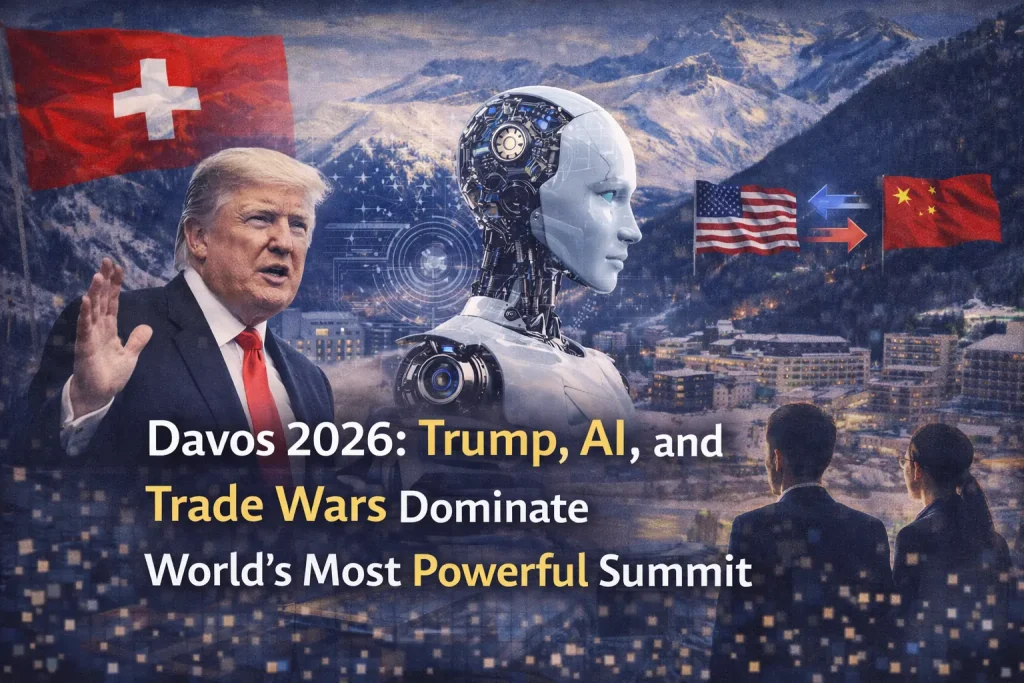
The World Economic Forum’s annual gathering in the Swiss Alps has transformed into a high-stakes diplomatic showdown, with President Donald Trump’s aggressive trade policies and the AI revolution taking centre stage at what many are calling the most consequential Davos in decades.
Nearly 3,000 global leaders descended on this mountain resort town this week for the 56th Annual Meeting, but the usual talk of economic cooperation has been overshadowed by geopolitical tensions that threaten to reshape the world order.

The Ultimate Dubai Business Setup Guide for 2026!
- Introduction: Davos 2026 and Its Global Significance
- Trump’s Controversial Return and Trade War Impact
- US-Europe Tensions: Greenland Tariffs and Trade Deal Suspensions
- Artificial Intelligence (AI) as the Key Forum Focus
- Global Risks Report 2026: Geoeconomic and Inequality Threats
- China and Other Strategic Players at Davos 2026
- Climate Change and Policy Debates Amid Geopolitical Crisis
- Conclusion
Introduction: Davos 2026 and Its Global Significance
Davos has long served as a meeting point for politics, business, and technology. In 2026, its relevance has grown as leaders confront overlapping crises rather than isolated challenges.
Trade disputes, technological disruption, and inequality are no longer separate debates, but deeply connected risks shaping policy decisions worldwide.
Key Themes in 2026
- Trade wars and geopolitical tensions.
- Artificial intelligence and technological disruption.
- Economic inequality and global risks
Also Check: Singapore Updates Cross-Border Withholding Tax
Trump’s Controversial Return and Trade War Impact
President Donald Trump’s third appearance at Davos quickly became one of the forum’s defining moments. His announcement of 10% tariffs on eight NATO allies, including Denmark, Germany, and France, linked to his Greenland initiative, drew swift criticism from European leaders.
French President Emmanuel Macron warned that Europe “will not yield to coercion,” while other officials cautioned that such measures risk undermining already fragile transatlantic relations.
Markets reacted quickly, with European stocks dipping and investors reassessing global supply chain risks. Analysts say the tariffs could have lasting effects on trade flows and corporate planning if tensions continue.
US-Europe Tensions: Greenland Tariffs and Trade Deal Suspensions
The tariffs linked to the Greenland dispute have triggered a broader political response in Europe. Denmark chose not to attend the forum, while the European Parliament is considering suspending approval of an existing US-EU trade agreement.
European officials have also discussed the possible use of the bloc’s Anti-Coercion Instrument, signalling that the EU is prepared to defend its economic interests if negotiations fail. The episode highlights the growing intersection between geopolitics and trade policy.
Artificial Intelligence (AI) as the Key Forum Focus
Alongside trade, artificial intelligence has emerged as one of the most discussed topics at Davos 2026. Business leaders and policymakers highlighted AI’s potential to boost productivity and economic growth, with projections suggesting significant contributions to global GDP over the next decade.
At the same time, concerns were repeatedly raised around:
- Workforce displacement and job restructuring
- Rising energy demand from AI infrastructure
- Unequal access to AI-driven gains
Several speakers stressed that without coordinated governance, AI could widen existing economic divides even as it drives innovation.
Also Check: Google and Character.AI Settle Teen Suicide Lawsuits Linked to AI Chatbots
Global Risks Report 2026: Geoeconomic and Inequality Threats
The World Economic Forum’s Global Risks Report 2026 provides a sobering backdrop to the discussions. Geoeconomic confrontation, including tariffs and sanctions, is identified as a major short-term risk. Over the longer term, inequality remains the most interconnected global challenge.
The report warns that economic fragmentation could deepen divisions between countries and income groups, while diverting attention away from other systemic risks, including climate change.
China and Other Strategic Players at Davos 2026
China used the forum to project stability amid Western tensions. Vice Premier He Lifeng emphasised domestic consumption, long-term growth, and economic continuity, positioning Beijing as a steady global partner amid uncertainty.
Other countries also used Davos to quietly reassess alliances and trade strategies, reflecting a broader shift toward a more fragmented and multipolar global economic system.
Climate Change and Policy Debates Amid Geopolitical Crisis
Climate change discussions at Davos have taken a backseat as trade and AI dominate the agenda. Policymakers expressed concern that urgent geopolitical conflicts could delay global climate action, highlighting the challenge of addressing multiple crises simultaneously.
Conclusion
Davos 2026 reflects a world navigating multiple pressures at once. Trade tensions, artificial intelligence, and inequality are reshaping global economic priorities, while traditional models of cooperation face a growing strain.
As leaders depart the Swiss Alps, the effectiveness of this year’s forum will be judged not by dialogue alone, but by whether it leads to meaningful policy action in an increasingly divided world.
Stay Ahead With The Leadership Circle
- Join The Leadership Circle Newsletter & receive our latest articles, updates, and publications directly in your inbox.