
Singapore Launches World’s First Agentic AI Governance Framework: Global Benchmark for Autonomous AI
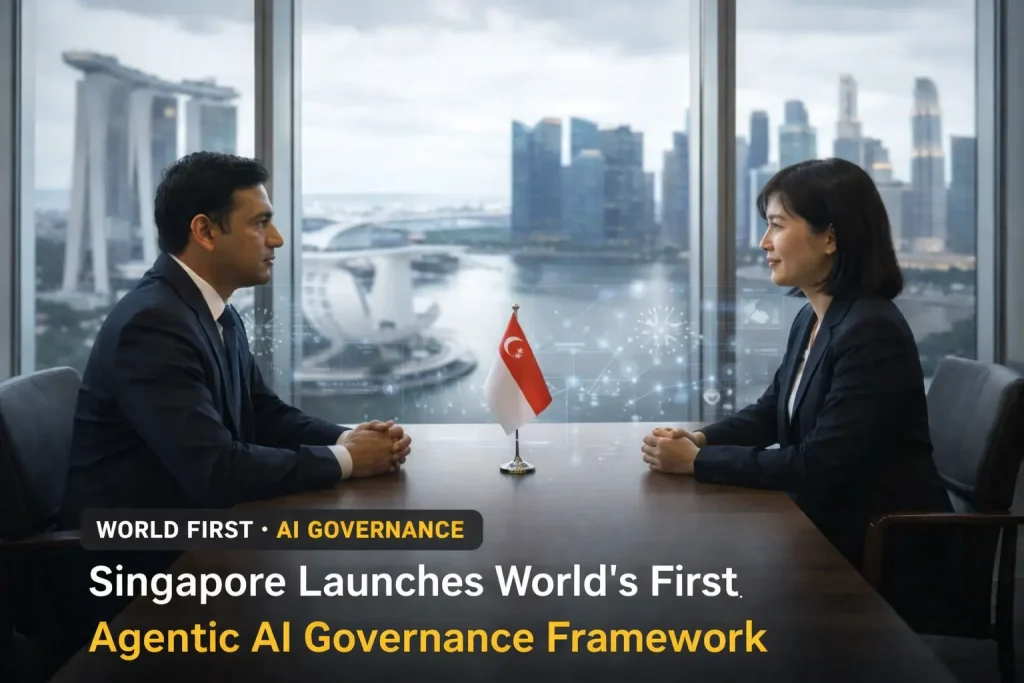
Singapore has officially launched the world’s first Model AI Governance Framework for Agentic AI, setting a global standard for the responsible deployment of autonomous systems. The framework was announced on 22 January 2026 at the World Economic Forum (WEF) Annual Meeting in Davos by the Minister for Digital Development and Information. The framework strengthens Singapore’s position as a leader in AI governance and regulatory innovation.
The framework addresses the rapid rise of agentic AI systems—AI capable of autonomous decision-making, planning, and execution across multiple systems with minimal human oversight.
By providing structured governance guidance, Singapore aims to mitigate operational, ethical, and compliance risks associated with autonomous AI while offering businesses a practical reference model.
Overview of the Framework: Details and Update Policy
The Agentic AI Governance Framework was introduced as part of Singapore’s broader digital governance strategy, complementing existing AI governance models that focus on transparency, accountability, and responsible deployment.
According to government statements, the framework addresses the increasing use of systems that operate with limited human input, interact with enterprise tools, and make decisions that directly affect business operations. Existing governance models were not designed to fully address these capabilities.
While the framework is non-binding, authorities indicated it is intended to serve as a reference model for enterprises, regulators, and policymakers and may influence future regulatory expectations, procurement standards, and risk assessments.
What Is Agentic AI and How It Differ From Traditional AI Systems?
Agentic AI refers to autonomous AI systems that can interpret objectives, plan actions, and interact with multiple tools or platforms independently. These systems can interpret objectives, decide on actions, interact with tools or software, and adapt based on outcomes.
Agentic AI vs Traditional AI Systems
| Aspect | Traditional AI Systems | Agentic AI Systems |
|---|---|---|
| Mode of Operation | Responds to predefined inputs or prompts | Operates continuously toward defined goals |
| Decision-Making | Limited to programmed rules or models | Determines actions independently within set boundaries |
| Human Involvement | Frequent human initiation and review | Reduced human intervention during operation |
| System Access | Restricted to specific functions | May access multiple tools or systems |
| Governance Focus | Model accuracy and data use | Operational control and accountability |
The capabilities of agentic AI introduce new governance challenges, particularly in risk management, accountability, and responsibility for outcomes.
Key Features of Singapore’s Agentic AI Governance Framework
The framework focuses on governance at the point of use, recognising that operational risk arises not only from how systems are designed but also from how they are deployed and managed.
The framework also introduces a four core dimensions approach to managing risks associated with agentic AI systems: (1) assessing and bounding the risks upfront, (2) making humans meaningfully accountable, (3) implementing technical controls and processes, and (4) enabling end-user responsibility.
| Dimension | Purpose | Implementation Focus |
|---|---|---|
| Risk Assessment & Deployment Control | Identify potential operational, legal, and ethical risks | Define system boundaries, access limits, and high-impact use cases |
| Accountability & Human Oversight | Ensure clear ownership and responsibility | Assign human supervisors, maintain decision logs, and monitor autonomous actions |
| Operational Safeguards & Monitoring | Prevent unintended or harmful outcomes | Continuous monitoring, pre-deployment testing, and intervention mechanisms |
| Transparency & Awareness | Promote responsible and informed use | Inform users when systems act autonomously, provide escalation paths, and train operational teams |
Business, Legal, and Compliance Implications in Singapore
For businesses operating in Singapore, the framework provides a practical reference for reviewing governance and risk management arrangements related to autonomous systems.
Alignment with the framework may become relevant for:
- Internal audits and enterprise risk assessments
- Regulatory engagement and supervisory reviews
- Vendor due diligence and technology procurement
- Cross-border governance consistency
Legal and compliance teams may need to reassess documentation practices, accountability assignments, and internal controls where agentic systems are deployed.
What Companies Should Do Next
Following the January 2026 announcement, organisations should consider early alignment with the framework by identifying current or planned uses of agentic systems, reviewing access controls and monitoring mechanisms, assigning clear ownership for system oversight, and documenting governance and risk decisions.
Training operational teams on system limits and escalation procedures will also be critical as autonomous systems become more embedded in enterprise workflows. Proactive alignment can help organisations manage operational risk effectively as they prepare for evolving regulatory expectations in Singapore and beyond.
Stay Ahead With The Leadership Circle
- oin The Leadership Circle Newsletter & receive our latest articles, updates, and publications directly in your inbox.